Friday, 24 June 2011

Does it make sense to build "affordable" housing in Santa Monica?

Among the people I admire most in the urban research business is Marjorie Turner.  I was talking to her at a conference sometime within the last year, and she put a difficult question to me: shouldn't housng policy allow everyone who wants to live in Bethesda, Maryland the opportunity to do so?  (Bethesda is among Washington, D.C.'s most affluent suburbs).

I have been pondering this question for some time, and it was thrown into relief for me when I witnessed a person bragging about building affordable housing units at $650,000 a pop in Santa Monica.  The presentation brought me around to the view that it is not society's responsibility to assure that everyone gets to live anywhere they like, just as it is not society's responsibity to buy everyone a Mercedes Benz (a night on the town every now and then might be something else).

Every household should have the opportunity to live in a clean, safe community with a decent school.  For this reason, expanding the Section 8 housing vouchers program, which allows low income households to rent market rate housing while paying no more than 30 percent of income, would make a lot of sense.  Given the fiscal realities of the moment, a sensible source for funding an expansion would be the Low Income Housing Tax Credit Program--a program that funds $650,000 properties in Santa Monica.

The median price of a house in Los Angeles County is around $275,000.  The median neighborhood in LA County is a fine neighborhood.  So one could put someone in a decent house and a decent neighborhood and still have $375,000 left over relative to Santa Monica.  That $375k could go toward better schools, more transportation options--or more housing! 

Do I wish everyone who wanted to live in Santa Monica could do so?  Sure.  I also wish everyone who wanted to take a vacation to Paris could take a vacation to Paris.  But when resoureces are scarce and getting scarcer, it is important to use them as effectively as possible.

Thursday, 23 June 2011

Do bond holders think it is all political theater?

The GOP pull-out of the budget talks today really worried me--it raises my subjective probability of a US default, which would be potentially catastrophic.  But when I looked at long-term bond prices on Bloomberg, they suggest the bond markets are completely calm.


Tuesday, 21 June 2011

How well off are Americans?

As Alice Rivlin notes, tax increases on the rich (which are, in my view, necessary and, in light of recent changes in income, appropriate) are not enough to bring about long-term fiscal balance (the short run is another matter--fiscal tightening at the moment makes no sense to me).  So the question is, in the long term, how far down the income distribution should we go when we ask Americans to sacrifice?

An OECD report, Growing Unequal? Income Distribution and Poverty in OECD Countries, provides country ranks for average income for ten income deciles.  For the top four deciles, seven, eight, nine and ten, Americans earn more than their counterparts in all other countries, save Luxumbourg, a country whose population is about the same as Dane County, Wisconsin.  For the next decile down, only people in the Netherlands and Luxembourg have higher average incomes.  One could argue, then, that anyone in the top five deciles is pretty well served by being an American.

Things turn a little worse after that: the fifth decile ranks five; the fourth ranks 6, the third ranks 10th, the second ranks 14th and the bottom decile ranks 19th!  In light of this, it seems reasonable to say that the median and below is about the place where we might not wish so ask for more sacrifice.

(BTW, thanks to my USC student Sarah Mawhorter for digging the data out of the report for me).

Alice Rivlin on the Budget (h/t Mark Thoma)

She writes:

Republicans worry that spending caps will threaten national security and Democrats that domestic needs will suffer. Both need to recognize that not all government money is well spent. Democrats are terrified of entitlement reforms and Republicans of tax increases, but there will be no solution without some of each. On entitlements, Democrats have to accept that the status quo is not an option and Republicans that draconian benefit cuts are not acceptable. On revenues, Democrats have to recognize that the debt can’t be stabilized just by taxing the very rich; the middle class will have to contribute too. Republicans have to recognize that in the face of a rapidly increasing older population, it is undesirable to hold spending at historic levels, so we need more revenues. Both parties should recognize that entitlements and earmarks in the tax code are the same as spending, and phasing them out can enhance growth.


No way out?

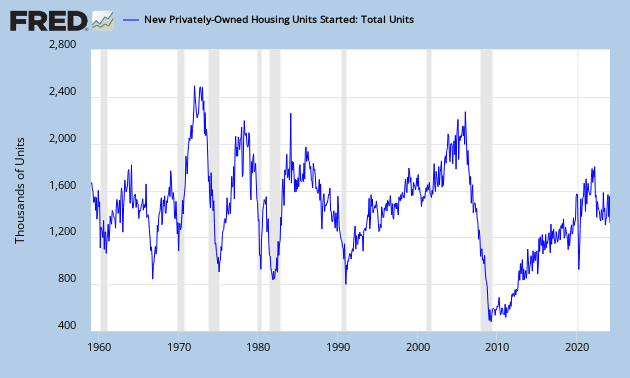
At a Rand meeting yesterday, Stuart Gabriel called housing the "tail that wags the dog" of the US economy.  He was likely referring to this paper or, perhaps, this paper.  In any event, the evidence from past business cycles powerfully supports residential construction as a leading indicator.

Here is the St. Louis Fed's depiction of housing starts going back to 1959:


In an average year, the US economy starts around 1.5 million houses.  It has started fewer than 600,000 per year since 2008, and is currently squiggling along at a bottom unprecedented in the St. Louis Fed series.

I find it hard to see how the economy can recover strongly without housing making a comeback.  Yet we still have too many houses--builders cannot compete with the inventory currently available. While they try to differentiate new houses from stuff in the foreclosure stock, it is tough to make a sale when price differences are very large.  The problem is that stimulating housing is a bad idea too, because we really don't need many more houses in the economy right now.  As my colleague Gary Painter points out, one of the reasons we don't need more houses is that household formations dropped dramatically--we actually lost households early in the recession while population grew.  Moreover, according to the Department of Homeland Security, illegal immigration dropped by 2/3 between 2000-2004 and 2004-2009.  Whatever one thinks about immigrants (personally, I like them), they do fill up houses.

We are left with a quandary.  For the economy to be restored to health, housing construction needs to return to normal--but there is no reason for it to return to normal.  The alternative--waiting--doesn't seem very appealing either.


Monday, 20 June 2011

There are days when it is hard to be a liberal

This afternoon I heard a woman say with a straight face that Santa Monica is committed to affordable housing.  This was after she bragged about the low density, high design standard, affordable housing that Santa Monica built.  What was the construction cost for the project?  More than $600,000 per unit--because each unit uses a lot of land, which is expensive in Santa Monica, and because of those "high design standards."

The median price of a house in Los Angeles County is about $300,000.    When a subsidized housing unit costs $600,000, the average person is implicitly paying a lucky family to live in a nicer than average house.  This is of course inefficient--it also undermines the consensus necessary to make sure everyone is housed adequately.

We do indeed have a huge problem in Southern California--many families do not have sufficient income to afford a reasonable unit in a location close to a job.  Building gold plated housing in Santa Monica does not help solve the problem.


Sunday, 19 June 2011

Places that voted for Obama have longer-lived women

The Washington post featured a story about life expectancy for women and men by county. The data come from the University of Washington's Institute for Health Metrics and Evaluation, and in particular a paper by Sandeep C Kulkarni, Alison Levin-Rector, Majid Ezzati and Christopher JL Murray.


The Post story contained a fun interactive map, and I could not help but notice that "blue" places appeared to have longer lived people. I couldn't help myself, so I downloaded data on elections from Mark Newman's website at the University of Michigan. Specifically, I downloaded data on the 2008 presidential vote by county.

I then drew a scatterplot in Stata of Obama's share of the Obama-McCain vote against women's life expectancy:


Again, the unit of observation is county.  The size of the dots reflects total votes by county.  The vote weighted correlation between women's life expectancy and share of Obama vote is .262, which is not insubstantial for a bivariate correlation.

One cannot draw any causal inference from any of this, of course, and my guess is that the Obama vote share is proxying for something else--perhaps educational attainment.   But drawing these pictures is fun (BTW, the correlation for Obama vote and men's life expectancy is a smaller .168).